


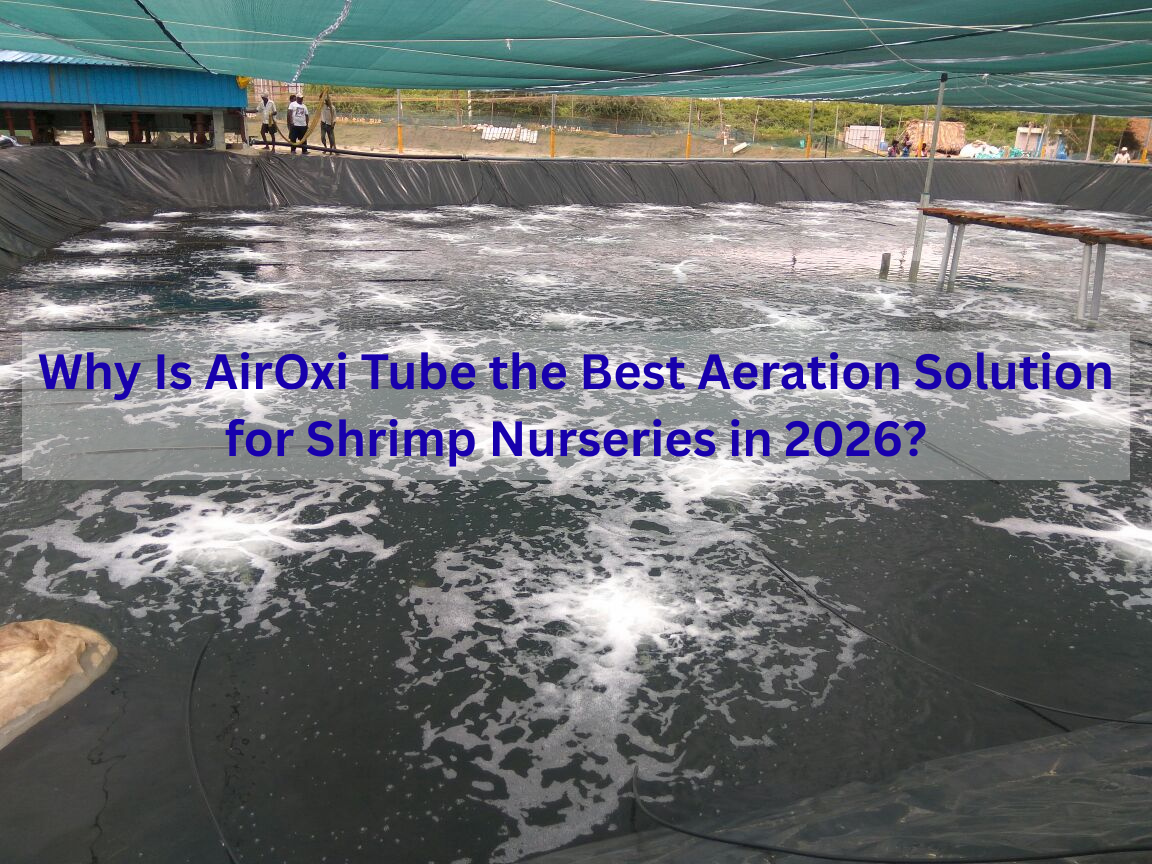
Why Is AirOxi Tube the Best Aeration Solution
for Shrimp Nurseries in 2026?
|
|

WhatMakesShrimpNurseryAerationDifferentFromGrow-OutPond Aeration?
Shrimpnurseriesoperateatafundamentallydifferentscaleandbiologicalsensitivitythangrow-outponds. Post-larvae (PL) and early juvenile stages are extremely vulnerable to oxygen fluctuations, surface agitation,mechanicalinjury,andDOstratification.AnurserytankholdingPL5–PL20stageshrimprequires aeration that is:
- Gentle: No surface splash or mechanical turbulence that injures fragile post-larvae
- Uniform: No DO dead zones anywhere in the tank volume
- Continuous: Stable oxygen delivery through day and night without peak-load spikes
- Energy-efficient:Nurseryoperationsrun24/7—energycostperunitofoxygentransferreddirectly determines profitability
Standard paddlewheel aerators, air stones, and surface splashers fail on all four criteria when applied to high-density nursery systems. AirOxi micro-bubble tubes are purpose-built to meet every one of them.
HowDoAirOxiTubesMaintainOptimalDissolvedOxygeninShrimp Nursery Tanks?
AirOxi tubes release air through thousands of engineered micro-pores along their length, producing a uniform curtain of fine bubbles that rises slowly through the water column. This slow ascent maximises water-air contact time — the primary driver of oxygen transfer efficiency. In a shrimp nursery tank, this translates to:
- DOuniformity:Micro-bubblesdispersehorizontallyastheyrise,eliminatingverticalandhorizontal stratification
- HighSOTR:StandardOxygenTransferRateissignificantlyhigherperwattthansurfaceaeration methods
- Nodeadzones:Evenincircularorrectangulartankswithcorners,thedistributedbubblecurtain ensures consistent DO across 100% of the tank footprint
- Gentlewatermovement:Micro-bubblecolumnscreateslow,circularwatermovementwithout mechanical impellers — safe for PL5 and above
TheresultisanurseryenvironmentwhereDOremainswithin±0.3mg/Lofthetargetsetpointevenat peak stocking densities, without any mechanical stress to the animals.
Why Is AirOxi Tube Superior to Traditional Nursery Aeration Methods?
Technical Comparison: AirOxi Micro-Bubble Tubes vs. Conventional Nursery Aeration
|
Feature |
AirOxi Micro-Bubble Tubes |
Paddlewheel Aerators |
Air Stones / Diffusers |
|
Bubble Size |
Finemicro-bubbles(highsurface area) |
Large surface splash |
Medium to large bubbles |
|
OxygenTransfer Efficiency |
High—extendedwater-air contact |
Low — surface agitation only |
Moderate—largebubbles rise fast |
|
Surface Turbulence |
minimal |
High — injurious to PL |
Low to moderate |
|
DO Uniformity |
Uniform across full tank volume |
Surface-concentrated |
Column-concentrated |
|
Energy Consumption |
Up to 50% lower per unit DO |
High peak draw |
Low but inefficient at scale |
|
Maintenance |
Low — no moving parts |
High—paddles,motors, bearings |
Moderate — clogging risk |
|
Scalability |
Modular—anytanksizeor shape |
Fixed unit sizing |
Limited at high density |
|
Safe for PL Stages |
Yes — PL7 and above |
No—tooaggressiveforearly PL |
Partial—notuniformenough |

WhatAretheKeyTechnicalSpecificationsofAirOxiTubesforNursery Applications?
- TubeMaterial:High-gradeTPE (Thermplastic Elastomer)—flexible,chemicallyinert, and resistant to aquaculture disinfectants including mild chlorine and formalin
- Micro-PoreDensity:Hundreds ofprecisionmicro-porespermetre—uniformbubblereleasealong the full tube length
- OperatingPressure:Lowdifferentialpressurerequirement(typically0.02–0.05MPa)—compatible with standard low-pressure regenerative or roots blowers
- BubbleSize:1 -2 mm micro-bubbleswithhighsurfacearea-to-volumeratioformaximum oxygen transfer
- StandardLengths:Availablein1m,2m,andcustomlengths—easilyconfiguredtofitanytank geometry
- DOTargetRange:Optimisedfor5–8mg/L—theidealnurserywindowforLitopenaeusvannamei and Penaeus monodon
- BlowerCompatibility:Workswithallmajorlow-pressureblowertypes—regenerative,roots,and screw blowers
SalinityTolerance:Fullyfunctionalacross0–45ppt—suitableforfreshwateracclimationthroughfull marine nursery systems
- Temperature Range: 5°C–35°C operational range — covers all major shrimp-farming climate zones
How Should AirOxi Tubes Be Installed in a Shrimp Nursery Tank?
Installation for New Nursery Tank Setup
- TankLayoutPlanning:Calculatetotaltankfloorareaanddeterminetubespacing—typicallyone tube every 0.5–1.0 m of tank width for nursery-level density
- ManifoldSizing:SelectaPVCorHDPEmanifoldsizedtodeliverequalpressuretoalltubelines simultaneously — avoid pressure drop at far-end tubes
- TubePlacement:LayAirOxitubesflatalongthetankfloororsecurewithstainlesssteelclipsto PVC rails — tubes must lie flat to ensure even pore pressure
- BlowerSizing:MatchblowercapacitytototaltubelengthandrequiredDOtarget—1HP of low-pressure blower output works with approximately 30 meters of AirOxi Tube
- AirLineConnection:Connectindividualtubelinestothemanifoldstandard fittings
- DOCalibration:Oncethetankisfilledandrunning,calibrateinlineDOprobesagainstahandheld meter and adjust blower output until target DO is stable
Retrofit Into an Existing Nursery System
- Drain the nursery tank to below 20% volume
- Place AirOxi tube lines along the tank floor in a parallel grid pattern
- Run air supply lines up and over the tank wall to an external manifold
- Connecttoexistingblowerinfrastructure—verifypressuremeetsminimumtubeoperating specification
- Refill the tank slowly while monitoring DO rise to confirm even distribution across all zones
What Stocking Densities Can AirOxi-Aerated Nurseries Support?
With AirOxi micro-bubble aeration maintaining DO at 6–7 mg/L, nursery operators consistently report the following benchmark stocking densities — representing a 30–50% improvement over conventional aeration at the same DO target:seimprovementsaredrivenbyAirOxi'suniformityeliminatingthelocalisedhypoxicpocketsthatcausestress-driven mortality in high-density systems.
How Do AirOxi Tubes Reduce Energy Costs in Shrimp Nursery Operations?
Nursery operations run continuously — 24 hours a day, every day of the grow-out cycle. The energy cost of aeration is a baseline operational expense, not a peak event. AirOxi's structural advantage:
- Lowoperatingpressure:Micro-bubblediffusionrequiressignificantlylessblowerpressurethan forcing air through large-pore stones or driving paddlewheel impellers
- Higheroxygentransferperwatt:Moreoxygendissolvedperunitofelectricalenergyconsumed means fewer kilowatt-hours per kg of shrimp produced
- Noidleenergywaste:Unlikepaddlewheels,AirOxitubesmaintainDOuniformityevenatreduced blower output during cooler overnight periods
OperatorsrunningAirOxiindedicatednurserytanksreportenergysavingsof40–50%perunitofdissolved oxygen delivered, compared to equivalent paddlewheel setups — a direct reduction in cost per PL produced.

Frequently Asked Questions
Q: At what post-larval stage can AirOxi tubes be safely introduced into a nursery tank?
A:AirOxitubesaresafefromPL7onwards.Themicro-bubblesaresub-millimetreinsizeandrisegently— there is no impeller, paddle, or mechanical surface agitation that could injure nauplii or early post-larvae.
Q: Do AirOxi tubes clog in high-algae or biofloc nursery systems?
A: EPDM micro-pores are self-cleaning under normal operating pressure. In high-biofloc or algae-dense systems, a weekly 30-second dry-run flush keeps pores clear. Full cleaning is recommended every 60–90 days.
Q: Can AirOxi tubes be used in biofloc-based shrimp nurseries?
A: Yes. AirOxi is highly compatible with biofloc technology (BFT) nursery systems. The gentle water circulation supports floc suspension without mechanical shear that destroys floc structure — a significant advantage over paddlewheel systems in BFT nurseries.
Q: What blower type is recommended for AirOxi nursery installations?
A: Regenerative or turbine blowers are preferred for smaller nursery setups (under 50 m of tube total). For larger or multi-tank manifold systems, roots blowers provide more stable pressure across longer runs.
Q: How do AirOxi tubes perform in round (circular flow) nursery tanks?
A: AirOxi tubes can be laid in a spiral or concentric ring pattern in circular tanks, creating a rotating bubble curtain that complements natural circular current — improving both DO distribution and waste collection at the central drain.
Q: Are there any ready to use setup with tubes and ballast available for ease of installation?
A: AirOxi Spider is a ready to use aeration device that can be used as a plug and play system with blowers.
2026 freshness signals included throughout
- Species-specific DO targets (L. vannamei and P. monodon) for technical credibility
Explore the full AirOxi product range at airoxitube.com | Technical resources and installation guides at
airoxi.com
